Introduction
It’s easy to perform facial motion capture for 3D animated characters using a TrueDepth-equipped iPhone and an app such as Epic Games’ Live Link Face. For a minimal setup, you can place the iPhone on a tripod or desk tripod and position yourself in front of it.
There are some limitations, however. Your range of motion is restricted because you need to remain reasonably close to the stationary phone and mostly facing it. If you move out of view or turn your head too far, tracking data can jitter, freeze, or become inconsistent. This can be restrictive for VTubing, performance capture, and productions that require significant body movement.
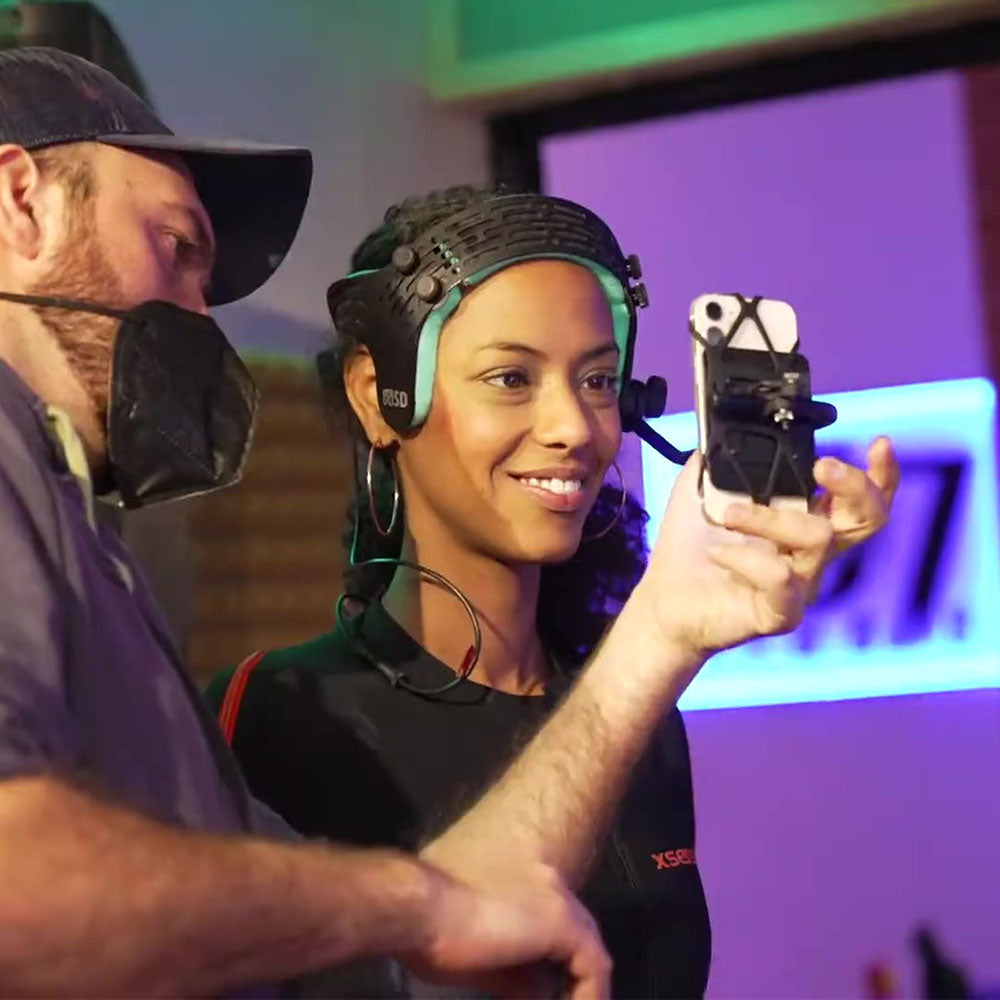
The solution is to use an HMC, or head-mounted camera, also commonly called a facial mocap helmet, so the iPhone moves with your head. Its front-facing TrueDepth camera remains focused on your face while you move, act, or perform. The TrueDepth system projects and reads thousands of invisible infrared dots to create a depth map of the performer’s face, allowing facial movement and expressions to be tracked in 3D. An HMC acts sort of like a selfie stick for your head: you can move freely while the phone remains consistently positioned and framed relative to your face.
The ideal motion capture helmet is lightweight, stable, comfortable, and properly balanced. A poorly designed head rig can introduce camera shake, cause discomfort or neck strain, ultimately wasting production time by delivering noisy or unrealistic facial tracking.
With the iPhone securely mounted via a quality HMC, its data can be combined with data from full-body motion capture systems, including optical, inertial, or Vive-based tracking, as well as hand and finger capture from mocap gloves or optical tracking systems. The facial capture data can then drive the facial rig of a 3D character alongside the body and hand animation.
The resulting animation can be used live for stage performance, virtual production, VTubing, or streaming on platforms such as YouTube and Twitch. Stability becomes especially important when several motion capture systems are being used together. If facial tracking is unreliable, you may have to discard entire takes and repeat performances even when the body and hand capture were otherwise good.
Real-time facial mocap commonly uses Apple ARKit’s facial tracking system, including more than 50 blend-shape coefficients, to capture facial movement and expressions. The latest versions of Epic Games’ Live Link Face also support capture using non-TrueDepth cameras, including other front- and rear-facing cameras on supported devices, providing additional options for MetaHuman animation.
For performances that don't need to be animated in real time, Epic Games’ MetaHuman Animator can produce highly realistic facial animation using video and depth data recorded by an iPhone’s TrueDepth camera. MetaHuman Animator can also generate animation from conventional mono video and other supported capture sources.
Alternatively, video from iPhones or other phones capable of recording suitable resolution and frame rates can be used with software from Faceware and other facial motion capture developers for tracking, solving, and editing facial animation.
What should you look for in a facial mocap helmet?
A useful HMC should keep the phone stable relative to the performer’s face while remaining comfortable enough for extended sessions.
Important factors include:
- Stability: Unwanted movement between the phone and the performer’s face can introduce tracking noise and motion blur.
- Weight and balance: A lighter, well-balanced rig reduces fatigue and neck strain.
- Adjustability: The camera needs to maintain a consistent view of the performer’s face.
- Freedom of movement: The performer should be able to turn, walk, and act naturally. The ability to capture fast or acrobatic movement is a major advantage when the helmet is stable enough to support it.
- Compatibility: The mount should hold the phone securely and allow it to be positioned correctly for facial capture.
For simple seated recording, a tripod-mounted iPhone may be all you need. For performance capture, VTubing, full-body mocap, or any situation where the performer needs to move naturally, a head-mounted solution becomes much more useful.
FaceCam is designed to provide a stable, lightweight, adjustable iPhone mounting system for facial motion capture while allowing the performer to move freely and even perform acrobatics.
Have questions about getting the best face mocap results while saving time and money?
Tell us what you're trying to do and what equipment you have or are considering.
Whether it's live performance, streaming, VTubing, content creation, research, or integration with body and hand capture, we can help you sort through the options.
We can help with phone choice, fit, balance, fast motion, multi-actor use, and choosing the FaceCam accessories that actually make sense for your setup—so you get what you need without unnecessary purchases or extra shipping later.
We'll give you straightforward advice, including when FaceCam is, or isn't, the right fit compared with other HMC options.
Ask us about your mocap setup →For comparisons of nearly every iPhone face mocap helmet,
please check out our comprehensive guide.